
Favre Leuba Makes an Impressive Return with the Sporty Chief Collection
Favre Leuba Makes an Impressive Return with the Sporty Chief Collection

Now in its fourth year, Geneva Watch Days is shaping to be one of the most interesting and exciting watch events of the year and one of the biggest stories of the fair is the return of legacy brand Favre Leuba. Not only is the fact that one of the oldest names in watchmaking is getting a fresh lease on life, but it’s particularly exciting that industry veteran Patrik Hoffmann is at the helm. Hoffmann has been a leading force in the watch industry for some time; he was CEO of Ulysse Nardin until 2017 and more recently served as Executive Vice President of Watchbox and was involved in that brand’s acquisition of De Bethune.
The combination of Hoffmann’s experience and Favre Leuba’s long history and rich back catalogue is an exciting one, as Hoffmann has proven himself to be a sophisticated operator with a track record of taking brands with a rich heritage and making them relevant for a modern audience, and Favre Leuba sure has a rich heritage.
The 287-year history of Favre Leuba
Favre Leuba is a name that has been around for literally centuries, dating its origin story back to 1737, when Abraham Favre set up shop as an independent watchmaker in Le Locle, one of the hubs of Swiss watchmaking. Throughout the 18th and 19th centuries, Abraham and his successors built a steady international business for their watches, notably becoming the first Swiss brand to enter the Indian market in 1865, under the leadership of Fritz Favre. In 1908, Henry Favre Leuba took control of the company, remaining in charge until 1961, and it was in this era that the modern identity of Favre Leuba as a sporty, adventurous watch brand was formed.
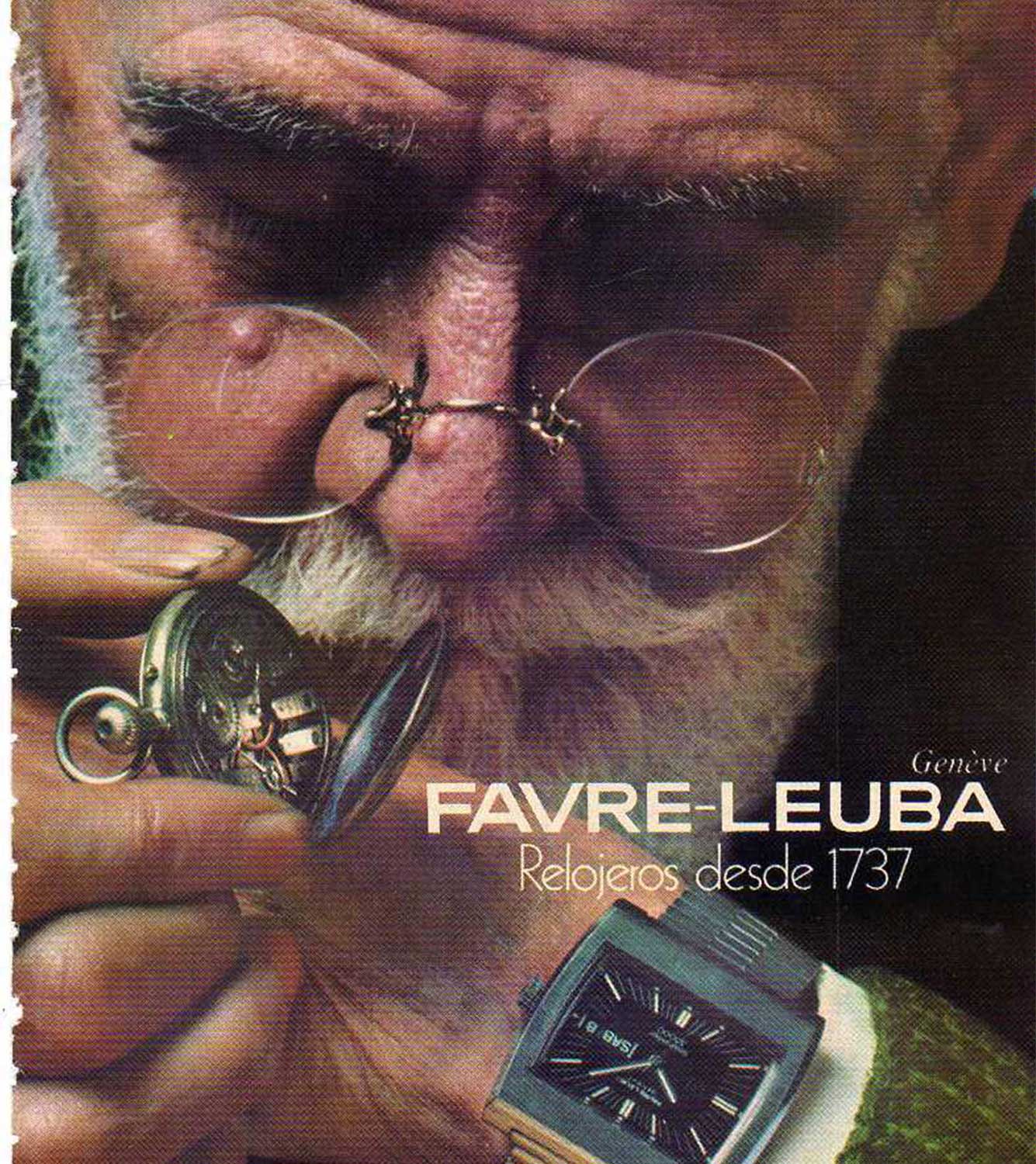
Abraham Favre was first mentioned as an independent watchmaker in Le Locle. (Image: Favre Leuba)

Henry Favre Leuba (Image: Favre Leuba)

Favre Leuba became the first Swiss watch brand to enter India when Fritz Favre travelled to the country in 1865. (Image: Favre Leuba)
In 1962, the brand released the Bivouac, the first watch equipped with an aneroid barometer, used for measuring altitude. They followed this innovation up with the Bathy in 1968, which took things to the other extreme, by incorporating a mechanical depth gauge into the watch. These tool-like functions were paired with some bold, colourful styles which encapsulated the spirit of the time. Family ownership of the brand ended in 1985 when the brand was one of the many casualties of the quartz crisis. In recent years, the brand has been fairly quiet, but this new beginning is promising, not just because of the incredible potential in the archives and history, but also in the strength of the team operating out of the Grenchen HQ.
Hail to the Chief
As befits Favre Leuba’s new beginning, the brand has chosen to reimagine its mainstay Chief collection, a sporty, 70s-inspired line of watches still with adventure at their very heart. CEO Patrik Hoffman explains the significance of this line and its design inspiration: “The cornerstone of Favre Leuba’s relaunch is the Chief collection. The original piece that inspired this collection, the 1970 Chrono Valjoux 23 hand-wound, already featured a square-curved case that softened slightly at the four corners. With the Chief, our goal is to develop a complete collection that will incorporate a variety of movements of different sizes in the future, embodying the full potential of our renewal with elegance and innovation.”

1970 Chronograph Valjoux 23 hand-wound (Image: Watches83)
The Chief collection is an important part of Hoffmann’s broader approach, which will see the brand extend its international footprint while offering a clearly structured catalogue of three families, each equipped with distinct movements. This makes for a solid and comprehensive offering right from the start. Favre Leuba intends to compete with the major players in the market, and the Chief is one of the most important tools at their disposal.
The Chief Chronograph
The spirit of the 70s is strong in the Chief Chronograph, with a 41mm, bezel-less case with a dynamic, faceted, cushion-like appearance, accentuated by the grooved flanks which follow the lines of the sporty pushers and streamlined lugs, which flow into the integrated steel bracelet, with sleek H-links. Of course, there’s a rubber option for those who want their sports watch even sportier.

Favre Leuba Chief Chronograph with a blue sunburst dial
Impressive as the case profile is, it’s the dial the eye is immediately drawn to. The layout is modern, with hefty splashes of vintage inspiration evident in the baton numerals and minute track. Favre Leuba’s emblem — a stylised hourglass — sits above the six o’clock position. In terms of colour, there are three options at launch, all in a vibrant sunburst. Black and dark blue are popular choices and hard to fault, but it’s the ice blue version that is the clear standout — thanks to the high contrast dial elements. The dynamism of the dial is further enhanced by the raised subdials of the bi-compax chronograph registers, along with the applied, rhodium-plated hands and markers, all coated in Super-LumiNova.
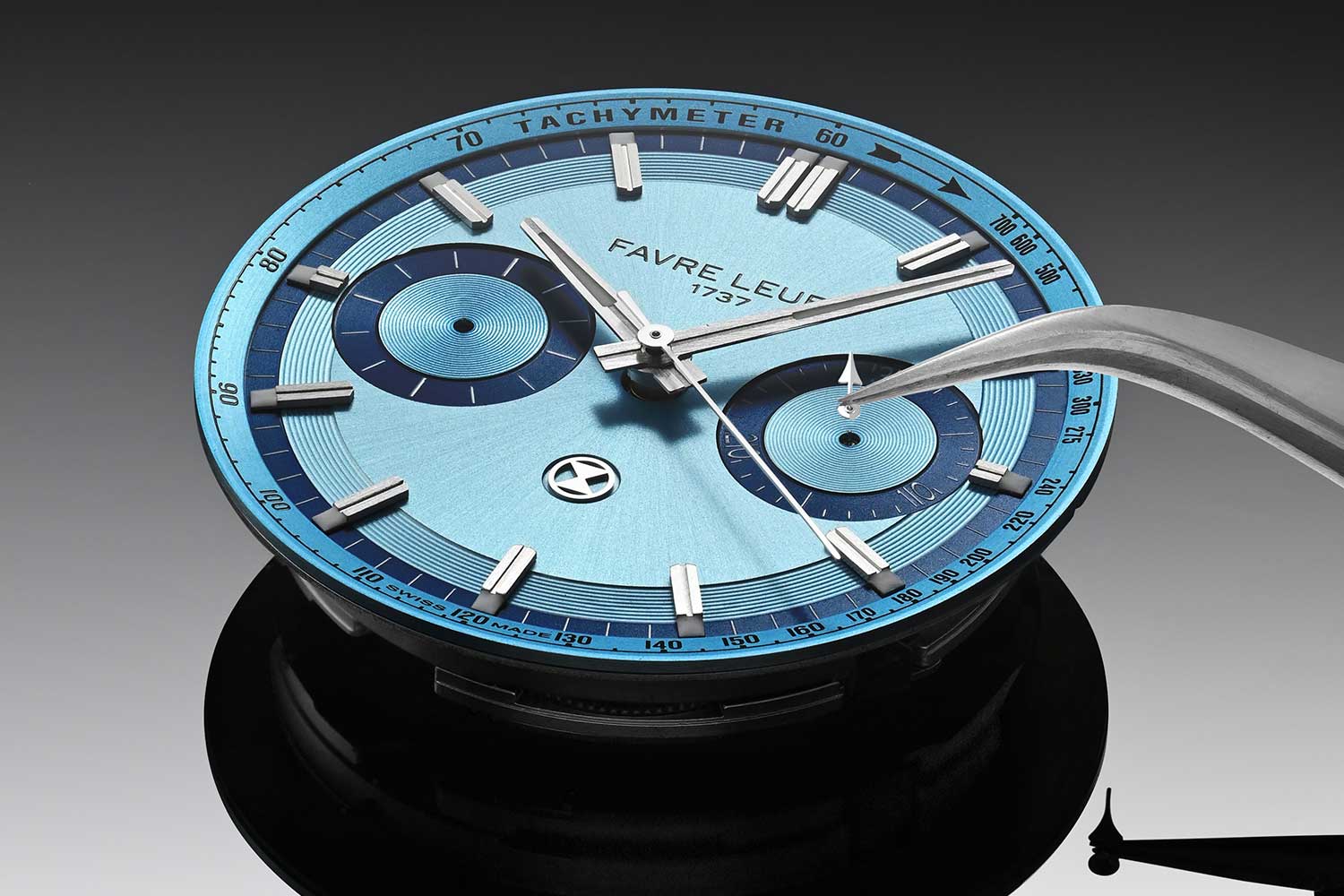
The ice blue dial features contrasting dark blue accents

Automatic-winding La Joux-Perret L113 chronograph movement
When it comes to the calibre, the Chief Chronograph is running the La Joux-Perret L113, a very interesting choice of chronograph calibre. It’s based, as are most modern automatic chronographs around this price, on the venerable Valjoux 7750. Don’t go thinking that the L113 is a simple clone of the 7750; it’s a bit more than that. La Joux-Perret has replaced the cam-and-lever actuator with a column wheel, and upped the power reserve to 60 hours. It’s quite an impressive movement, and you can admire it through the open caseback.
The Favre Leuba Chief Chronograph will retail for CHF 4,500.
The Chief Date

The Chief Date collection comprises sunray-finished dials in three colors: green, blue, and black
Following the same essential form factor as the Chief Chronograph, the Chief Date offers a slightly smaller (40mm) and simpler proposition, though still with plenty of charm. And while the funk-adjacent lines of the case are the same, the dial is quite different. Instead of opting for a plain sunburst finish, Favre Leuba has instead chosen a more textured option — a stamped tapestry pattern of interlocking, high-relief hourglasses, accented by an off-centred sunray finish. The colours on offer are black and blue, as before, but now they are joined by a verdant green number.

The chiseled case features both satin-finished and polished surfaces

Automatic-winding La Joux-Perret G100 movement
The calibre the brand has opted for is just as impressive. Again, they’ve stuck with La Joux-Perret, utilising the G100 — a movement designed to be compatible with cases made for the ubiquitous ETA 2824. However, the G100 goes above and beyond the capabilities of the ETA, with a very solid 68-hour power reserve, making it an excellent option for a modern daily automatic. It’s quite an attractive movement, too, with diamond-cut bevels, blued screws, and Geneva stripes on the movement and rotor.
The price of the Favre Leuba Chief Date will be CHF 2,500.
Even though Favre Leuba is one of the oldest names in watchmaking, it’s early days for this iteration. However, the initial signs are very strong, and if everything goes according to Hoffmann’s plan, the brand will have what it takes to contend with some of the biggest names in the Swiss industry. There’s a clear visual identity in the Chief that has been smartly updated for modern sensibilities and a broad appeal. It also has a quality to back up the design — the case construction is sophisticated and boasts plenty of nice details, while the La Joux-Perret is very solid. Finally, the price is right. The Chief collection is pitched exactly where it needs to be at the more accessible end of the prestige segment. All things being equal, the future of Favre Leuba should be just as remarkable as its past.
Favre Leuba